

In 2025, the global technology landscape was reshaped by an unprecedented artificial intelligence boom fueled by billions of dollars in investment from the world’s largest tech companies into AI infrastructure. Aggressive spending on advanced semiconductors, data centers, and cloud computing capacity accelerated the deployment of large-scale AI systems, driving corporate revenues and pushing US stock indexes to record highs.
Market optimism surged as investors bet heavily on AI’s transformative potential across industries ranging from finance to healthcare. Yet beneath the enthusiasm, concerns have grown more pronounced. The rapid rise of interconnected funding rounds, strategic partnerships, and cross-investments has prompted warnings from financial institutions and industry experts that speculative excess may be building, raising questions about whether the current momentum reflects sustainable growth or the early signs of an AI-driven market bubble.
Read More: Why Selecting a Digital Marketing Agency in the USA Often Takes Longer Than You Think
Billion-Dollar Circular Deals Fueling the AI Boom in 2025
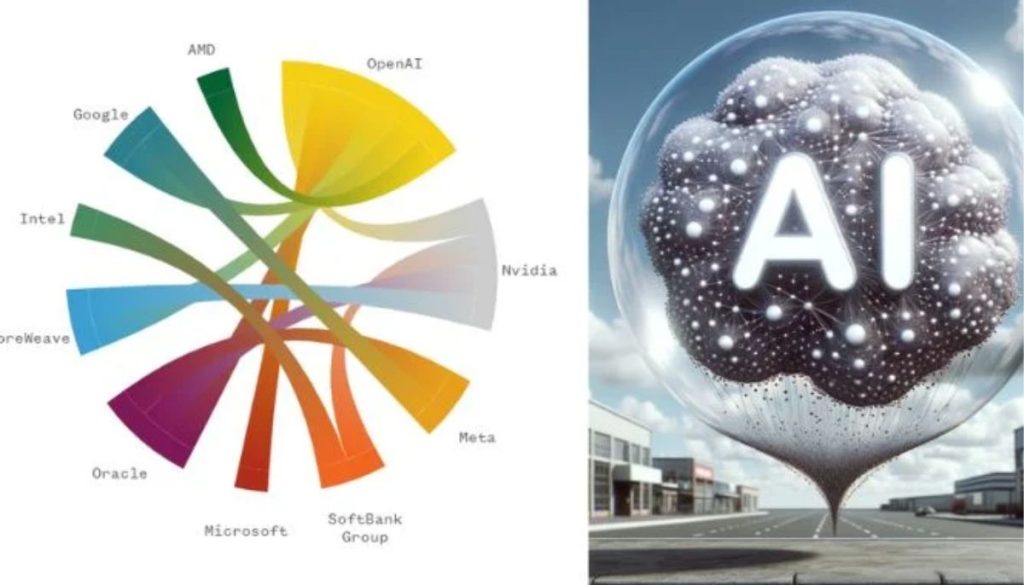
A web of multibillion-dollar, interlinked deals has emerged as a defining force behind the artificial intelligence boom in 2025, with OpenAI at the center of an increasingly complex ecosystem of partnerships, investments, and supply agreements. OpenAI has entered advanced talks with Amazon over a potential investment exceeding $10 billion, a move that would deepen Amazon’s push to sell its AI chips and cloud computing services to the ChatGPT maker while reshaping competitive dynamics across the sector.
Entertainment conglomerate Disney has also announced a $1 billion investment in OpenAI, alongside a three-year licensing agreement granting access to characters from Pixar, Marvel, and Star Wars. Beginning next year, OpenAI’s Sora and ChatGPT platforms are expected to generate AI-produced video content featuring iconic figures such as Mickey Mouse, Cinderella, and Mufasa.
On the hardware front, OpenAI has partnered with Broadcom to develop its first in-house AI processors and has struck a multibillion-dollar agreement with Advanced Micro Devices, under which OpenAI will purchase AMD chips while the chipmaker may acquire up to a 10 percent stake. Nvidia, meanwhile, has committed $100 billion to OpenAI to support the construction of 10 gigawatts of AI data centers powered by millions of GPUs.
Cloud infrastructure deals further underscore the scale of investment. OpenAI has agreed to purchase $300 billion in computing capacity from Oracle over five years, while CoreWeave has signed a separate five-year, $11.9 billion contract. These arrangements are further intertwined through Stargate, a joint venture between OpenAI, Oracle, and SoftBank aimed at expanding global data center capacity, highlighting both the ambition and the growing complexity underpinning the AI boom.
Meta’s Key Deals
Meta has also moved aggressively to secure the computing power needed to scale its artificial intelligence ambitions, striking deals with companies that already play a central role in OpenAI’s ecosystem. The Facebook parent has signed a $14 billion agreement with CoreWeave to access high-performance computing capacity, underscoring intensifying competition for AI infrastructure.
According to Reuters, Meta has additionally entered into a six-year cloud computing partnership with Google, a notable collaboration between two long-time rivals as demand for AI-ready cloud resources outpaces supply. Oracle is also in advanced talks with Meta over a multi-year cloud computing agreement valued at approximately $20 billion, further highlighting how leading tech firms are increasingly relying on shared infrastructure partners to meet the soaring computational demands of next-generation AI systems.
Google’s Deals With Other Firms
Google is expanding its artificial intelligence footprint through large-scale infrastructure investment and strategic talent acquisitions. The company plans to invest $40 billion by 2027 to build three new data centers in Texas, a move aimed at strengthening its cloud and AI computing capacity amid surging global demand.
In parallel, Google has deepened its technology capabilities by hiring staff from Windsurf, securing key engineering talent while accelerating product development. As part of the arrangement, Google will pay $2.4 billion in licensing fees to use Windsurf’s technology, reflecting the growing premium placed on proprietary AI tools and expertise as competition among major players intensifies.
Nvidia’s Strategic Deals
Nvidia has continued to cement its dominance at the center of the AI ecosystem through a series of high-value strategic deals. Most recently, the chipmaker agreed to license technology from AI startup Groq in a cash transaction valued at $20 billion, marking the largest acquisition of assets in Nvidia’s history and reinforcing its push to enhance next-generation AI chip performance.
Nvidia has also joined forces with Anthropic and Microsoft in a landmark partnership, under which Microsoft is set to invest up to $5 billion and Nvidia up to $10 billion in the AI startup. In return, Anthropic will provide as much as one gigawatt of computing capacity powered by Nvidia’s advanced Blackwell GPUs.
Further strengthening its infrastructure footprint, CoreWeave placed a $6.3 billion initial order backed by Nvidia, which has committed to purchasing any unsold cloud capacity from the provider. Nvidia has also expanded its semiconductor investments with a $5 billion stake in Intel, underscoring its strategy of securing both supply chains and compute capacity amid intensifying global AI demand.
Growing Concerns Over an AI Bubble
Amid the surge of massive, AI-driven dealmaking, concerns about the formation of an AI bubble have intensified since midyear, with some analysts drawing parallels to the dynamics that preceded the 2008 global financial crisis. The scale and speed of capital flowing into artificial intelligence infrastructure, startups, and cross-investment arrangements have raised alarms about potential systemic risks.
According to an analysis by MacroStrategy Partnership, the current AI bubble dwarfs previous market excesses, measuring roughly 17 times larger than the dot-com bubble of the 1990s and four times the scale of the 2008 financial crisis. In 2025, both the International Monetary Fund and the Bank of England echoed these concerns, warning that the rapid escalation in company valuations tied to AI optimism could leave markets vulnerable to a sharp correction if expectations fail to align with underlying economic fundamentals.
Frequently Asked Questions
What is driving the AI boom in 2025?
The AI boom in 2025 is being driven by unprecedented investments from major technology companies in AI infrastructure, including advanced chips, cloud computing, and large-scale data centers. These investments are aimed at supporting increasingly powerful AI models and applications.
What are “circular deals” in the AI sector?
Circular deals refer to interconnected investments where tech firms simultaneously act as investors, customers, and infrastructure providers to one another. While these arrangements accelerate growth, they also blur financial exposure and risk.
Which companies are at the center of these AI deals?
OpenAI, Nvidia, Meta, Google, Microsoft, Amazon, Oracle, and AMD are among the key players, forming a tightly linked ecosystem through multibillion-dollar investments, chip supply agreements, and cloud computing contracts.
Why are experts concerned about an AI bubble?
Analysts worry that company valuations are rising faster than underlying revenues or real-world AI adoption. The heavy concentration of capital and leverage in a small group of firms raises fears of a sharp correction if expectations fall short.
How does the current AI boom compare to past bubbles?
According to market analysts, the current AI bubble is significantly larger than previous ones, estimated to be 17 times bigger than the dot-com bubble and four times the size of the 2008 financial crisis.
Have regulators issued warnings?
Yes. In 2025, institutions such as the International Monetary Fund and the Bank of England warned that the rapid escalation in AI-related valuations could pose financial stability risks if the market overheats.
Conclusion
The AI boom of 2025 highlights both the transformative potential and the mounting risks of artificial intelligence. Multibillion-dollar investments, intricate partnerships, and unprecedented infrastructure expansion have propelled tech giants to new heights, reshaping the competitive and financial landscape. At the same time, the scale and velocity of these deals have fueled concerns about an AI-driven market bubble, with analysts and global regulators warning of potential systemic risks if valuations outpace sustainable growth.
