

Artificial intelligence (AI) is often perceived as a tool for automation and the replacement of human labor. Recent research from Swansea University challenges this perception, revealing that Study AI can enhance human creativity by inspiring ideas and fostering engagement rather than merely executing tasks. Researchers in the University’s Computer Science Department conducted one of the largest studies to date examining human-AI collaboration in creative design.
The online experiment involved over 800 participants who used an AI-powered platform to generate virtual car designs. Results indicate that AI not only accelerates the design process but also stimulates innovative thinking, suggesting that the technology functions as a creative partner rather than a replacement, reshaping how humans approach design and problem-solving.
Read More: How Tech Giants’ Billion-Dollar Bets Are Powering the 2025 AI Boom
Fostering Creativity Through Design Diversity
Many AI design tools focus on optimizing outcomes without actively involving users in the creative process. In contrast, the system used in this study employed a technique called MAP-Elites to present participants with a diverse range of visual design options. The resulting galleries included highly effective solutions, unconventional ideas, and even intentionally flawed examples, encouraging participants to explore a broader spectrum of possibilities.
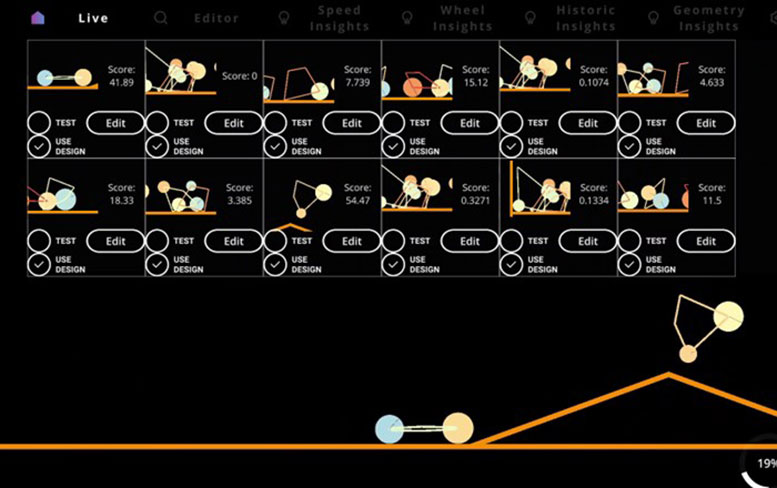
Turing Fellow Dr. Sean Walton, Associate Professor of Computer Science and lead author of the study, emphasized the impact: “AI is often seen as a tool for speeding up tasks or boosting efficiency, but our findings reveal a different story. When participants engaged with AI-generated suggestions, they spent more time exploring, produced higher-quality designs, and felt genuinely involved. It was about creativity and collaboration, not just efficiency.”
Rethinking AI Design Tool Evaluation
The study, published in ACM Transactions on Interactive Intelligent Systems, reveals that conventional approaches to evaluating AI design tools may be too limited. Metrics such as click rates or frequency of copied suggestions capture only surface-level interactions, overlooking the emotional, cognitive, and behavioral dimensions of engagement. The Swansea team advocates for more holistic evaluation methods that examine how AI influences how people feel, think, and explore during creative work.
Dr. Sean Walton, lead author and Turing Fellow, noted, “Our findings underscore the value of diversity in AI outputs. Participants responded most positively to galleries featuring a wide range of ideas, including deliberately imperfect ones. These options helped users move beyond initial assumptions, explore a broader design space, and embrace creative risk-taking.”
He added, “As AI increasingly integrates into creative fields—from engineering and architecture to music and game design—understanding how humans and intelligent systems collaborate becomes crucial. The focus is not only on what AI can do but on how it can help us think, create, and collaborate more effectively.”
Reference: Walton, S. P., Evans, B. J., Rahat, A. A. M., Stovold, J., & Vincalek, J. (2024, March 7). From Metrics to Meaning: Time to Rethink Evaluation in Human–AI Collaborative Design. ACM Transactions on Interactive Intelligent Systems. DOI: 10.1145/3773292
Frequently Asked Questions
What was the main goal of the study?
The study aimed to explore how AI can support human creativity in design, not just automate tasks. Researchers investigated how AI-generated suggestions influence engagement, exploration, and creative outcomes.
How was the study conducted?
Over 800 participants used an AI-powered platform to create virtual car designs. The system presented a wide variety of design options using a method called MAP-Elites, including highly effective, unconventional, and intentionally flawed designs.
What did the study find about AI and creativity?
AI can enhance creativity by encouraging exploration, preventing early fixation on familiar ideas, and stimulating innovative thinking. Participants spent more time on tasks, produced higher-quality designs, and felt more engaged when interacting with diverse AI suggestions.
Why is diversity in AI output important?
Exposure to a broad range of design ideas, including imperfect ones, helps users challenge assumptions, experiment, and take creative risks, ultimately improving design outcomes.
How should AI design tools be evaluated?
Traditional metrics like clicks or copied suggestions are insufficient. The study suggests holistic evaluation methods that measure emotional, cognitive, and behavioral engagement to understand the full impact of AI collaboration.
What are the broader implications of the research?
As AI becomes more integrated into creative fields—from engineering to music and gaming—understanding human-AI collaboration is essential. The focus shifts from what AI can do to how it can enhance thinking, creativity, and teamwork.
Conclusion
The Swansea University study challenges the notion that AI simply replaces human effort, revealing instead that it can act as a powerful partner in creative work. By presenting diverse design options—including unconventional and imperfect ideas—AI encourages exploration, prevents early fixation, and fosters innovative thinking. Traditional evaluation metrics, focused solely on efficiency or task completion, fail to capture the full impact of human-AI collaboration.
