
A market can be moving higher while investors prepare for larger price swings. Equally, falling prices do not always mean expectations of volatility are increasing. Direction and expected volatility describe different aspects of market conditions.
GIFT Nifty and India VIX help explain this distinction. The former provides a traded futures price linked to the Nifty 50, while the latter measures expected volatility derived from Nifty options. Reading them together adds context, provided you understand their different time horizons and limitations.
Two indicators with different roles
GIFT Nifty futures trade on NSE International Exchange, or NSE IX, at GIFT City. The exchange offers US dollar-denominated Nifty derivatives, with trading extending beyond domestic equity-market hours. This allows participants to respond to developments while India’s cash market is closed.
A rise or fall in the futures contract can indicate changing expectations for Indian equities. However, the futures price is distinct from the underlying index value.
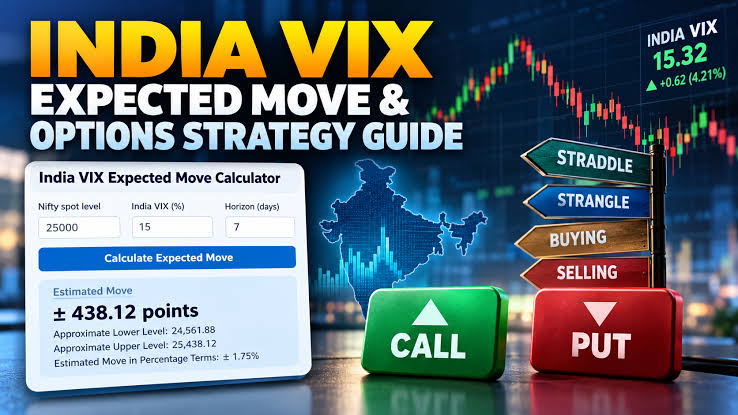
India VIX serves another purpose. NSE calculates it using Nifty options quotations to estimate expected volatility over the next 30 calendar days. Its value is expressed as an annualised percentage, rather than a forecast of the index’s percentage change over those 30 days.
Direction does not explain the expected size of moves
GIFT Nifty can help you observe whether the futures market is moving higher or lower. It cannot establish how smoothly the domestic market will trade after opening.
India VIX adds information about the expected magnitude of fluctuations. A higher reading indicates greater expected volatility, while a lower reading indicates less. It does not specify whether prices will rise or fall.
This distinction prevents two common misinterpretations: assuming a rising market must be calm, or treating an increase in volatility expectations as a definite forecast of falling prices.
Reading the signals together
The following combinations offer a framework for interpretation rather than trading instructions.
GIFT Nifty rising and India VIX rising
The futures market is moving higher while options pricing reflects greater expected volatility. Investors may be responding positively to current developments while still preparing for substantial fluctuations.
An upward indication should therefore not be mistaken for confidence that the session will remain steady.
GIFT Nifty rising and India VIX falling
This combination suggests an upward futures move alongside lower expected volatility. It may appear more reassuring than a rise accompanied by increasing uncertainty.
Nevertheless, neither indicator guarantees that gains will continue. Fresh information can change both readings.
GIFT Nifty falling and India VIX rising
Here, a downward futures move coincides with increasing expected volatility. The combination can warrant closer attention to changing market conditions. It does not identify a market bottom or establish the eventual size of any decline.
GIFT Nifty falling and India VIX falling
Prices can move lower even as expected volatility eases. A decline in India VIX does not mean that the market must recover.
The useful distinction is between the direction currently being priced and the degree of future fluctuation reflected in options quotations.
Matching observation times matters
Before comparing the indicators, check when each value was recorded. An early-morning GIFT Nifty quote may incorporate overnight developments, while the India VIX figure beside it may still be the previous domestic session’s closing value. These observations do not describe an identical information set.
During periods when both markets are updating, compare reasonably aligned timestamps. If one reading is older, acknowledge that limitation instead of interpreting the pair as a simultaneous signal.
For GIFT Nifty, also check the contract expiry and the reference used for its displayed change. Comparing different contracts or inconsistent observation times can create a misleading impression of movement.
Avoid confusing futures premiums with market optimism
A futures contract trading above the previous Nifty 50 closing value does not automatically imply an equivalent opening gain.
Futures pricing reflects financing costs, expected dividends and time until expiry. These factors contribute to the difference between futures and spot prices, commonly called the basis. NSE’s educational material explains this through the cost-of-carry framework.
India VIX cannot remove that difference or convert a futures quotation into an exact opening forecast. The two indicators complement each other, but neither supplies the missing certainty.
Using the information without overreacting
For investors, the main benefit is understanding market conditions more clearly. The indicators can help explain why an apparently positive opening signal still accompanies caution, or why a declining market does not necessarily reflect rising volatility expectations.
They should sit alongside your investment horizon, asset allocation and liquidity needs. Neither measures a company’s earnings prospects, establishes whether an investment is attractively valued, or determines the suitability of your portfolio.
Avoid treating a single observation as a reason to change a long-term plan. Review the underlying development and whether it affects your financial goal before deciding on any action.
Conclusion
GIFT Nifty provides information about futures-market direction, while India VIX measures expected volatility. Together, they offer a fuller picture of market conditions, provided their timestamps and meanings are understood. Use them to interpret changing expectations, rather than to predict an exact opening, daily return or suitable investment decision.
Mutual Fund investments are subject to market risks, read all scheme related documents carefully.
This document should not be treated as endorsement of the views/opinions or as investment advice. This document should not be construed as a research report or a recommendation to buy or sell any security. This document is for information purpose only and should not be construed as a promise on minimum returns or safeguard of capital. This document alone is not sufficient and should not be used for the development or implementation of an investment strategy. The recipient should note and understand that the information provided above may not contain all the material aspects relevant for making an investment decision. Investors are advised to consult their own investment advisor before making any investment decision in light of their risk appetite, investment goals and horizon. This information is subject to change without any prior notice.
The content herein has been prepared on the basis of publicly available information believed to be reliable. However, Bajaj Asset Management Limited (formerly known as Bajaj Finserv Asset Management Limited) does not guarantee the accuracy of such information, assure its completeness or warrant such information will not be changed. The tax information (if any) in this article is based on prevailing laws at the time of publishing the article and is subject to change. Please consult a tax professional or refer to the latest regulations for up-to-date information.
